
Huntington Park Wood Flooring installs engineered hardwood flooring in Huntington Park, CA and the surrounding cities of Walnut Park, Florence-Graham, Maywood, Bell and Cudahy. Twenty years of working over both concrete slabs and raised wood subfloors across this part of Los Angeles County is what informs how we specify it, and the specification is where most of the value sits.
Engineered flooring is frequently sold as the budget alternative to solid wood, and that framing does it no favors at all. It is a genuine engineering solution: a real hardwood wear layer bonded over a dimensionally stable core, which handles concrete and humidity swings far better than solid timber does. There are conditions in this city, and plenty of them, where it is simply the correct answer rather than the compromise.
There are also conditions where it is the wrong one, and the difference usually comes down to wear layer thickness set against how long you intend to keep the floor. We specify against those two questions rather than against headline price, because a thin wear layer on a floor you plan to hold for twenty years is a false economy that only becomes visible at the first refinish, by which point nothing can be done about it.
Where Engineered Is the Right Choice
Over a Concrete Slab
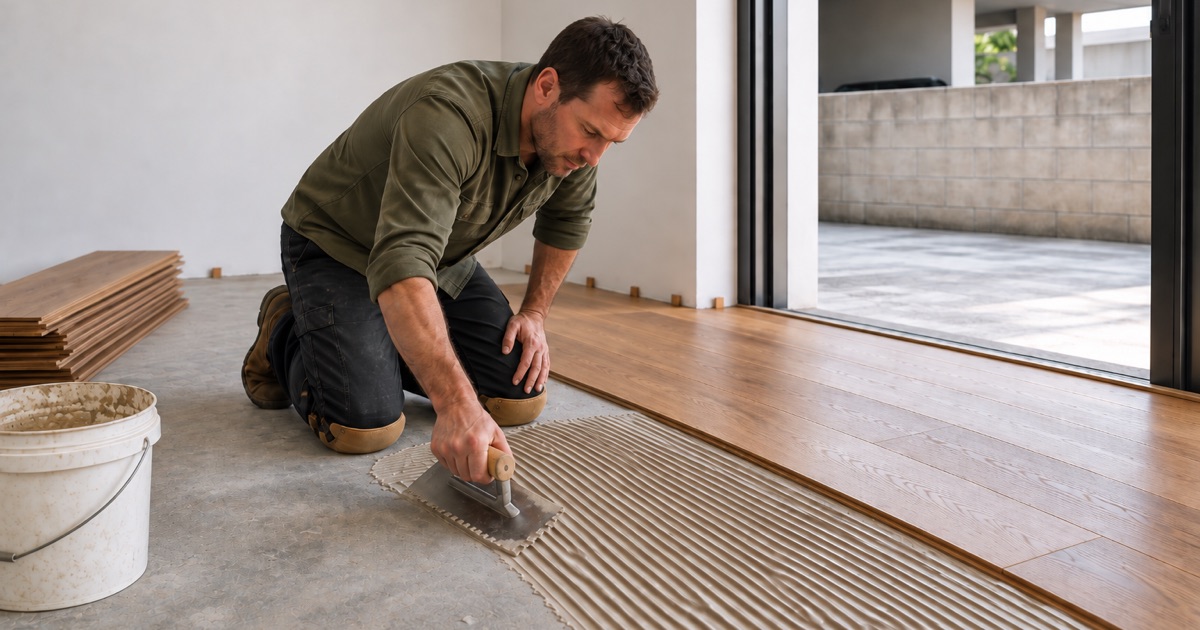
Concrete moves moisture upward for years after it is poured, and its surface humidity varies with the season regardless of how dry it feels. Engineered flooring tolerates that where solid wood frequently does not, which is why it dominates slab installations everywhere. Where the slab tests within range, engineered can be glued directly down, which produces a more solid feel underfoot and a quieter floor than a floating installation manages.
In Buildings With Humidity Swings
A unit standing empty between tenants, a building without consistent climate control, or a room that runs hot through summer all cycle the moisture content of whatever floor is in them. Engineered board moves considerably less across its width under that cycling than solid wood does. Gapping in winter and tightening in summer are both reduced, which matters most in exactly the rental and multifamily buildings that make up much of this city.
Where Build-Up Height Is Limited
Going over an existing floor, or matching into an adjoining floor that is staying put, sometimes leaves very little vertical room to work with. Engineered is manufactured in thinner profiles than solid flooring, so it can resolve a height constraint at a doorway or a threshold that solid wood could only solve by undercutting every door in the house or building up all the surrounding rooms to match.
Reading the Specification
Wear Layer Thickness
The wear layer is the actual hardwood on top, and it determines whether the floor can ever be sanded. A generous wear layer takes a full refinish, sometimes more than once across its life. A very thin one cannot be sanded at all and can only ever be screened and recoated. This single number decides the floor’s usable life more than any other, so it is what we quote against and what we ask you to compare between products.
Core Construction
Cores are typically plywood or high density fiberboard, and the two behave quite differently. Plywood cores hold a fastener properly and tolerate moisture better, which matters a great deal if the floor is being nailed to a wood subfloor. Fiberboard cores are flatter and usually cheaper, but they are far less forgiving if water ever reaches them, and in a rental that is not a remote possibility.
Species, Cut and Finish
The wear layer carries all the same choices a solid floor does: white oak at a Janka rating of 1360, red oak, hickory at 1820, and the visual difference between plainsawn, rift and quartered stock. A quartersawn wear layer shows medullary ray fleck exactly as solid quartersawn oak does, because it is the same wood cut the same way. Factory finishes are also generally harder than anything applied on site.
Installation Methods
Glue-Down Over Concrete
Glue-down bonds the floor directly to the slab with a moisture-control adhesive, producing the most solid feel underfoot and the quietest result of the three methods. It requires a slab within flatness tolerance as well as within its moisture limit, so grinding, patching or a self-leveling compound frequently comes first. That preparation is quoted openly rather than assumed away, because it is real work and it is not optional.
Floating Installations
A floating floor is not fastened to the substrate at all, which lets it tolerate minor substrate movement and go down quickly. It is the usual answer where a slab cannot be brought within adhesive tolerances without disproportionate preparation. It does feel and sound different underfoot, with a slight hollowness that some people notice immediately, so we say so plainly rather than letting it be discovered after the job is finished.
Nail-Down Over a Wood Subfloor
Where there is a sound wood subfloor, engineered flooring with a plywood core can be nailed or stapled down much as solid flooring is, using cleats or staples at the spacing schedule appropriate to the board width. This is common in the raised-foundation housing that makes up a large share of the older stock in this area, and it gives a result very close to solid wood underfoot.
Moisture Testing Before Anything Is Ordered
In-Situ Relative Humidity Probes
Slabs are tested with probes drilled into the concrete to the ASTM F2170 method, which reads conditions inside the slab rather than at its surface. Surface readings are misleading because a slab dries from the top down and can look ready while still holding moisture below. A slab reading above 75% relative humidity is not ready for flooring, whatever the schedule says, and we hold the job rather than install onto it.
Wood Moisture Content
Boards are checked with pin and pinless meters set to the species and cut actually going down, not left on a factory default that assumes something else. Flooring installed before it has reached equilibrium with the building is what produces winter gapping and summer cupping, and it is entirely avoidable with a meter and a few days of patience. We measure rather than count days, because the number is what matters.
Vapor Retarders and Adhesives
Where a slab is within range but not genuinely dry, a moisture-control adhesive or an appropriate vapor retarder bridges the gap. Which one applies depends on the reading, the product warranty and the installation method chosen. We record the reading in writing before ordering material, so the specification can always be traced back to a number rather than to a recollection of what the slab seemed like on the day.
Our Step-by-Step Installation Process
Substrate Survey and Testing
We establish what the floor is going onto before anything else: slab or wood subfloor, its flatness across the room, and its moisture condition measured rather than estimated. On concrete that means in-situ probes and a recorded reading. This visit decides which installation methods are actually available, and it happens before any product is selected.
Specification and Selection
With the substrate known, we specify wear layer, core type and installation method together, since those three decisions constrain each other. Samples are looked at in the room where the floor is going, in the light that room actually gets. Anything requiring slab preparation is priced at this point rather than appearing later as a variation.
Substrate Preparation and Acclimation
Grinding, patching or self-leveling happens where the flatness tolerance requires it, and the material is delivered and left to reach equilibrium with the building. We measure moisture content to confirm it rather than counting days on a calendar, because a warm empty unit and an occupied one condition a floor at quite different rates.
Installation and Handover
The floor goes down by the specified method, with expansion gaps maintained at every wall and fixed obstruction and transitions detailed at doorways. We confirm in writing what the floor needs in its first weeks, including when heavy furniture can be moved back and what maintenance the factory finish actually calls for.
- Licensed & Insured
- Free Estimates
- 20+ Years Experience