
Huntington Park Wood Flooring repairs water damaged hardwood floors in Huntington Park, CA and across Walnut Park, Florence-Graham, Maywood, Bell and Cudahy. Supply lines, water heaters, dishwashers, roof leaks and upstairs bathrooms account for most of what we see, and in a city where just over half the housing sits in buildings of two or more units, a leak in one unit is frequently a floor problem in another.
The single most important thing about a wet floor is that nothing can be decided about it until it is dry. Wood swells when it takes on water and shrinks again as it releases it, and a floor assessed while still wet will be assessed wrongly in both directions: boards that look ruined often flatten out, and damage that looks minor sometimes turns out to have reached the subfloor.
So the sequence matters more here than on any other job we do. Find the water, stop it, dry the structure under measurement, then decide what the floor needs. Sanding or refinishing a floor that is still carrying moisture guarantees the work fails, and it is the most common way a water-damaged floor ends up being paid for twice.
Establishing the Extent
Moisture Mapping
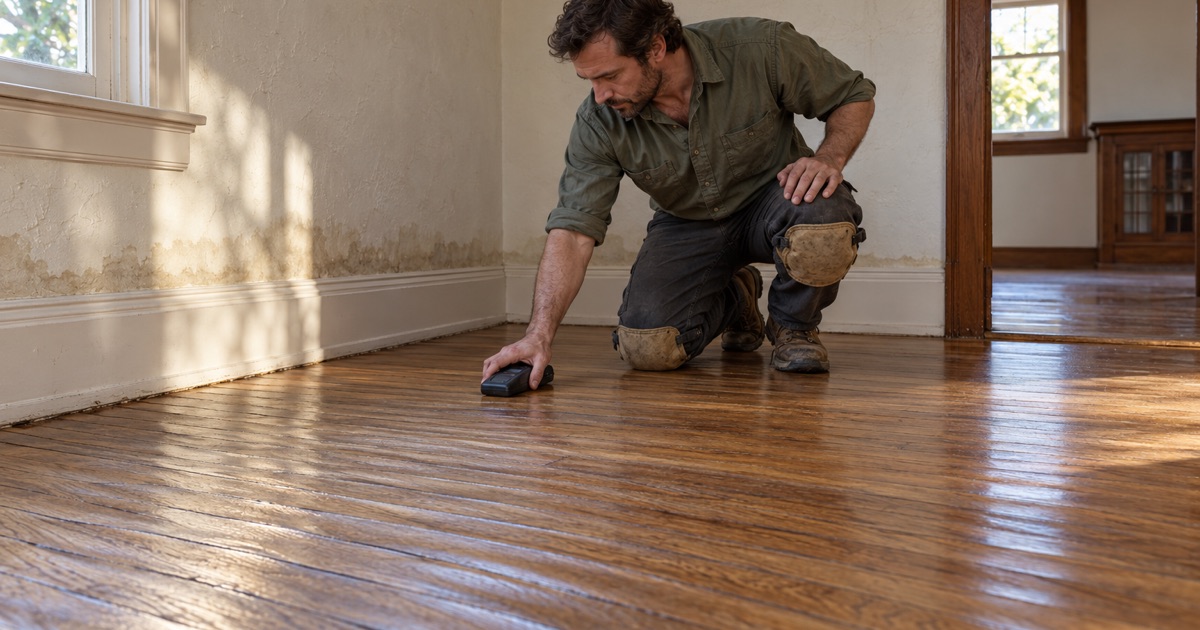
Water travels along the path the structure gives it, which is rarely the shortest one. It runs under boards, along joists and through wall plates, so the wet area is almost always larger than the visible stain. We map moisture with meters across the floor and into adjoining rooms to find the actual boundary rather than treating the discoloration as the edge of the problem.
Finding and Stopping the Source
Nothing proceeds until the source is stopped, and identifying it is not always straightforward: a stain at a doorway may originate several rooms away, and a recurring damp patch with no obvious plumbing above it often turns out to be arriving from the crawl space or from outside. Where the source falls outside our trade we say so plainly rather than working around it.
Checking Below the Finish Floor
Water that reached the finish floor generally reached the subfloor beneath it, and sometimes the joists. Where there is crawl space access we inspect from below, looking for staining, elevated moisture content, delamination in plywood and any sign of rot. Repairing a finish floor over a wet subfloor simply seals the moisture in where it can do more harm.
Drying Before Anything Else
Controlled Drying, Measured
Drying is monitored with meters rather than judged by appearance, because a floor can feel dry on top while the subfloor beneath it is still well above an acceptable range. Readings are taken across the affected area and recorded over time. The floor is not touched until those numbers reach the target for the species and the assembly.
Cupping That Recovers, and Cupping That Does Not
Boards that took on water from beneath swell on their lower face and lift at the edges. A good proportion of that flattens out as the floor releases moisture at an even rate, which is why patience saves boards. Where cupping persists after the structure has genuinely dried, or where boards have crowned or split, replacement is the answer.
Why Sanding Wet Wood Fails
Sanding a cupped floor flat while it is still wet removes the raised edges. As the boards then dry and shrink, what was flattened becomes concave and the floor ends up worse than before, with less wood left to correct it. This is the most expensive avoidable mistake on a water job, and it is entirely a question of sequence.
Repair, Replacement and Refinishing
Board Replacement and Weave-In
Where boards are beyond recovery they are removed and replaced, with new material matched to the original in species, width, thickness and cut, then woven into the surrounding field at staggered lengths so there is no continuous seam. On a pre-war floor this usually means sourcing reclaimed stock or having boards milled to the original profile.
Subfloor and Structural Repair
Delaminated plywood, deteriorated board subfloor and joists that have lost section to rot all get dealt with before any finish flooring goes back. A joist that has softened is usually sistered rather than removed. This work is far cheaper while the floor is open, and it is the part that decides whether the repair lasts.
Refinishing the Repaired Area
Once the structure is sound and dry, the repaired area is sanded flush and the finish is blended into the surrounding floor, or the room is refinished where the existing finish has aged too far to match into. We plan the stopping point at a room boundary or threshold, so the finished result reads as deliberate rather than as a patch that ran out.
Insurance, Landlords and Documentation
Working Alongside a Restoration Contractor
On larger losses a restoration company usually handles the emergency drying, and we come in for the flooring itself. Coordinating on the drying targets matters, because a structure signed off as dry to a general standard is not always dry enough for hardwood. We ask for the readings rather than assuming, and we will say if they are not sufficient.
Documenting for a Claim
Where a claim is involved, the useful record is photographs, moisture readings taken over time, and a written scope describing what was damaged and what was done. We provide that documentation as part of the job. What we do not do is advise on coverage or entitlement, which is a matter between the policyholder and the carrier.
Tenanted Property
In a rented unit the occupant reports the damage and the owner pays for the repair, so findings and readings go to the owner or the manager in writing. Where a leak in one unit has damaged the floor in another, establishing the path the water took is often the first thing anybody actually needs settled.
Our Step-by-Step Water Damage Process
Assessment and Mapping
We map the moisture, establish the boundary of the affected area, identify the source and inspect below the floor where access allows. This produces a scope that reflects the real extent rather than the visible stain, which is usually the difference between a repair that holds and one that reappears.
Drying to Measured Targets
Drying is monitored with readings recorded over time until the assembly reaches target for the species and construction. This is the stage that cannot be compressed to suit a schedule, and we will not sign off on a floor that has not reached it, because everything after depends on it.
Repair and Replacement
Unrecoverable boards are replaced with matched material woven into the existing field, and any subfloor or joist work is completed first. Where cupping has recovered on its own, boards that looked lost at the start of the job often need nothing at all.
Refinishing and Handover
The repaired area is sanded flush and blended, or the room is refinished, and cure and re-occupancy times are confirmed in writing. Photographs and the moisture record are handed over with the job, which matters particularly where a claim or a tenancy is involved.
- Licensed & Insured
- Free Estimates
- 20+ Years Experience