
Huntington Park Wood Flooring builds, retro-fits and refinishes hardwood stairs in Huntington Park, CA and the surrounding cities of Walnut Park, Florence-Graham, Maywood, Bell and Cudahy. It is the part of a wood flooring job that most general flooring companies quietly avoid, and it is the part most likely to be done badly when they do not.
Stairs are their own trade within this one. A floor is a flat plane; a flight of stairs is a series of individual components — treads, risers, nosings, stringers, landings — each of which has to be fitted to a slightly different dimension, because almost no staircase in an eighty-year-old house is uniform from top to bottom. Every tread gets measured individually.
They are also the most punished surface in any building. A stair takes concentrated foot traffic on a narrow strip of the tread, always in the same place, which is why stair nosings wear through long before the floor they connect to. In a small apartment building the common stair takes every tenant’s traffic and wears faster still.
Retro-Fitting Over an Existing Staircase
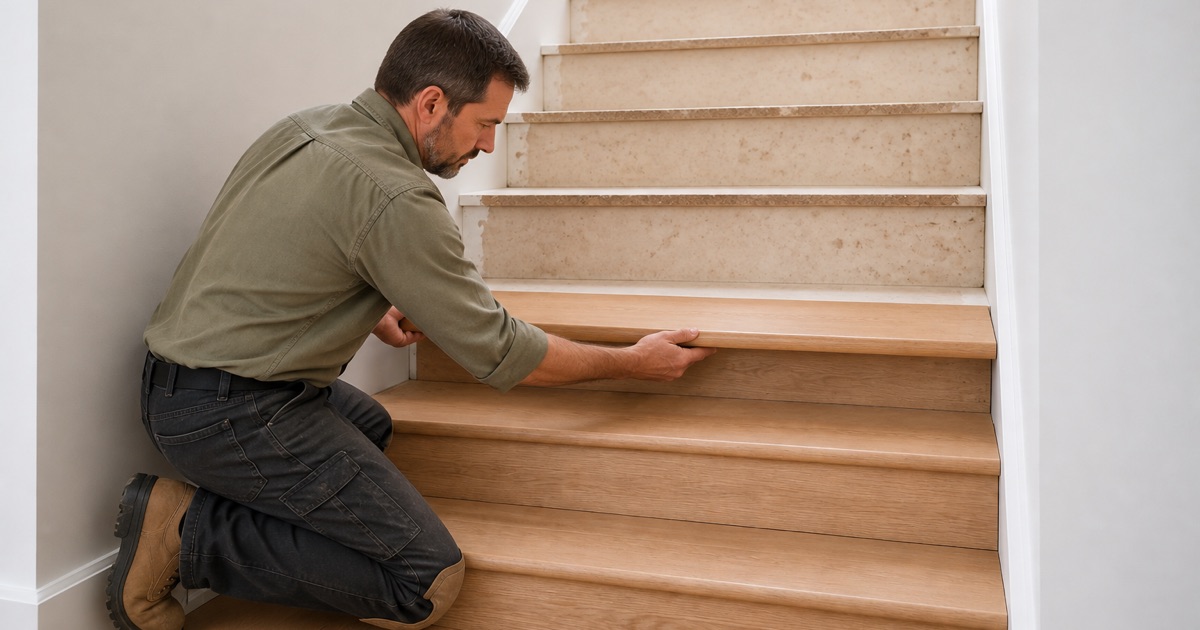
What a Retro Tread Actually Is
A retro tread is a hardwood tread milled to sit over an existing structural stair, typically where carpet has been removed. It carries its own bullnose at the front edge and is cut to the exact width of the flight. It converts a carpeted staircase to hardwood without rebuilding the structure underneath it, which is why it is the common answer here.
Measuring Every Tread Individually
Stairs in older houses are rarely uniform: treads vary in width and depth from top to bottom, and the flight is often slightly out of square with the walls. Every tread and riser is measured separately and cut to its own dimension. Cutting a set to a single average measurement is exactly how a retro-fit ends up with visible gaps at the walls.
The Bullnose and the Front Edge
The nosing is the projecting front edge, and it is the most heavily worn part of any staircase. A retro tread must carry a proper bullnose rather than a square edge, both because it is what a stair is expected to feel like underfoot and because a square front edge on a stair wears and chips far faster than a rounded one.
Refinishing an Existing Staircase
Why Stairs Wear Differently
Traffic on a stair concentrates on a narrow band of each tread, so wear appears as a worn strip in the middle of every tread while the edges look nearly new. That pattern means a staircase frequently needs refinishing well before the floors around it, and it is also why a stair cannot simply be recoated once the wear has reached bare wood.
Sanding a Flight by Hand
Almost none of a staircase can be reached by the machines that sand a floor. Treads, risers, nosings and the junctions between them are worked with small equipment and by hand, tread by tread. It is slow, and it is why refinishing a flight of stairs costs more per square foot than refinishing any other surface in a building.
Matching Into the Floors Either End
A staircase generally connects two floors that are being refinished at the same time, and the three have to read as one job. Species, stain and sheen are matched across all of them, which means testing on the stair as well as on the floor, since the same finish can look different on a vertical riser than on a horizontal plane.
Details That Decide the Result
Treads, Risers and How They Meet
The joint between a tread and the riser below it is where a staircase creaks and where a poor fit shows most. Each riser is scribed to the tread above and below it and fastened so the assembly cannot move. A tread that flexes even slightly under load will develop a creak, and creaks are far easier to prevent than to chase afterwards.
Landings, Returns and Newel Posts
A landing is a small floor and gets laid as one, with the board direction chosen deliberately rather than carried through by accident. Where a stair is open on one side, the treads need a return nosing on the exposed end so the end grain is not left showing. Newel posts and balustrades have to be worked around without being loosened.
Slip Resistance
A stair is the one surface in a building where the finish has a safety consequence. Higher-gloss finishes are more slippery underfoot than satin or matte, particularly in socks, and that matters more on a common stair in a rented building than almost anywhere else. We raise it at specification rather than after somebody has slipped on it.
Choosing Material for a Staircase
Species and Hardness
A stair takes concentrated wear on a narrow band, so species matters more here than on a floor. White oak at a Janka rating of 1360 is the common choice and holds up well. Hickory at 1820 is harder again and worth considering on a common stair in a rented building, where the traffic is several households rather than one.
Solid Treads Against Engineered
Treads are generally solid rather than engineered, because the nosing is a shaped edge that has to be milled from a solid section and because a tread has to take repeated impact on that edge. Engineered material has its place on the landing and the floors either end, but the tread itself is one component where solid is usually the right answer.
Grade and Appearance
Stair treads are seen edge-on and at eye level from below in a way floors never are, which makes grade more visible. A character grade with knots and mineral streak that reads well across a wide floor can look busy on a narrow tread. We generally select a cleaner grade for treads even where the adjoining floor is more rustic.
Our Step-by-Step Stair Process
Survey and Individual Measurement
Every tread and riser is measured separately, the flight is checked for square against the walls, and the structural condition underneath is assessed. Where carpet is coming off, what is underneath is not known until it is off, so the scope stays provisional until that point and we say so rather than quoting around it.
Structural Preparation
Loose treads are secured, creaks are traced and fixed, and any damaged structure is repaired before finish material goes on. This is the stage that decides whether the finished stair is silent, and it is almost impossible to revisit once the treads are fitted.
Fitting Treads, Risers and Nosings
Components are cut to their individual dimensions and fitted from the top down, with returns detailed on any open end. Fasteners are placed where they will be concealed by the component above, so the finished flight shows no face fixings.
Sanding, Finishing and Cure
The flight is sanded by hand, matched to the floors it connects, and finished with slip resistance considered in the sheen selection. Stairs cannot be avoided the way a room can while a finish cures, so the schedule is planned around access and confirmed in writing before the work starts.
- Licensed & Insured
- Free Estimates
- 20+ Years Experience